

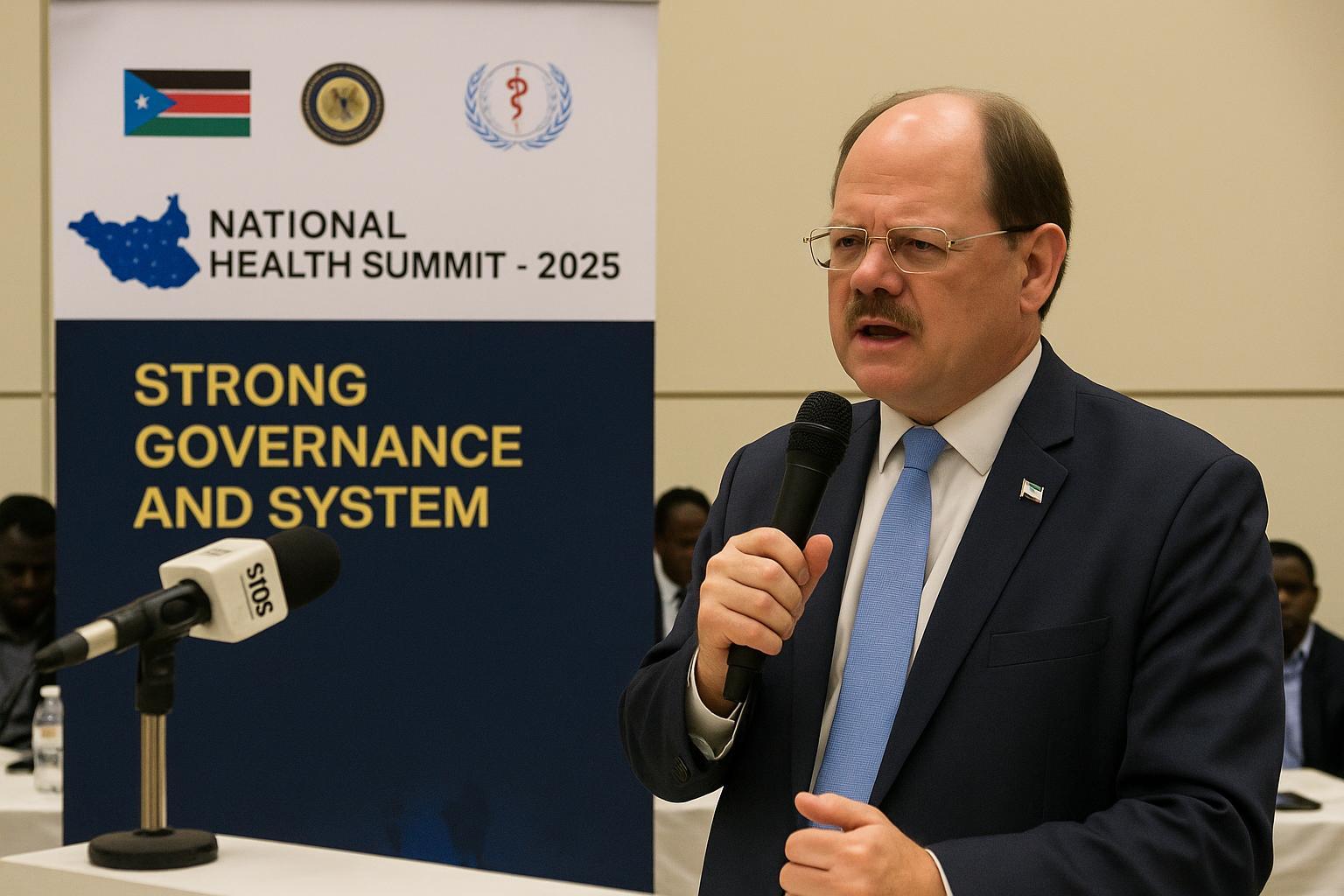
A Turning Point for Health Funding
At the National Health Summit in Juba, British Ambassador David Ashley warned that South Sudan’s medical lifeline, financed 85 percent by donors, is fraying under global budget cuts.
Speaking for partners like the World Bank and GAVI, he applauded frontline staff yet cautioned that external generosity can no longer substitute for consistent national investment.
Donor Reliance Nears Breaking Point
Ashley recalled visits to Kator Primary Health Care Centre and Al Sabah Children’s Hospital, where oxygen cylinders, syringes and even fuel were paid for with foreign checks.
The United Kingdom alone has channelled more than USD 800 million since independence, but future contributions, he said, “will not match previous levels”, mirroring reductions across the aid landscape.
Budget Priorities and Reforms
The envoy urged cabinet ministers to raise the health share of the national budget, guarantee punctual salaries, and assume control of infrastructure—from oxygen plants to incinerators—originally erected with pooled funds.
Efficient spending, transparent procurement and a sharper focus on sexual and reproductive health, he argued, could swiftly lower maternal mortality and restore public confidence.
Peace as a Public Health Pillar
Beyond spreadsheets, Ashley linked healthy communities to political stability, lamenting fighting that has displaced civilians, damaged hospitals and redirected scarce revenue toward security operations.
“We remain committed,” he said, “but real progress depends on lasting peace.” Observers note that health facilities often serve as informal cease-fire zones, underscoring how diplomacy and medicine intertwine.
What Comes Next
Summit delegates welcomed the challenge, promising a roadmap for domestic resource mobilisation before the next fiscal cycle.
If promises hold, analysts predict gradual shifts from donor-funded projects to state budgets, with partners transitioning from paymaster to technical adviser roles, a model already piloted in neighbouring Uganda.