

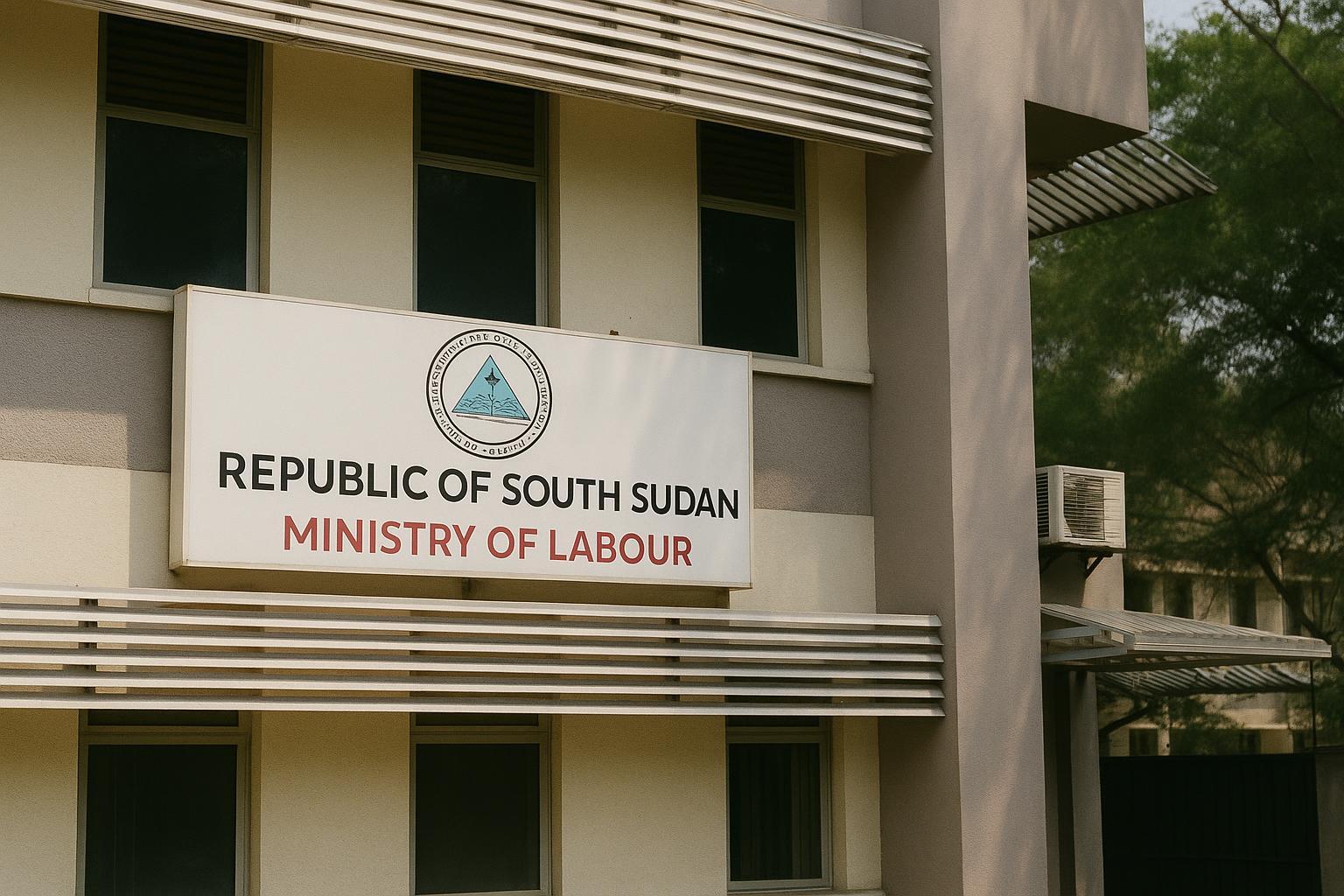
Government steps up enforcement
The South Sudanese Ministry of Labour has ordered every company, NGO and public body to confirm that all foreign staff carry valid work permits. The circular, dated 3 December 2025 and signed by Undersecretary Deng Kenjok, marks the toughest stance yet on undocumented employment.
Legal backbone and sanctions
Article 16(3) of the 2017 Labour Act requires a ministry-issued permit for every non-national worker. Employers hiring without one now face prosecution, heavy fines and possible closure, while undocumented staff risk deportation, according to the ministry notice.
“Non-compliance will be met with swift and decisive legal action,” the circular reads. Kenjok added in a briefing that inspections would be “surprise visits, not a public spectacle, but a legal necessity.”
Inspection rollout across industries
Nationwide audits are scheduled to begin immediately, with mixed teams targeting factories, offices and humanitarian projects alike. Officials say the operation is continuous, forming part of a broader plan to improve labour governance and protect opportunities for South Sudanese citizens.
Business reaction and expert views
Private-sector managers in Juba spent the week reviewing personnel files. “We have engineers still waiting on paperwork,” admitted a construction executive who requested anonymity, noting the potential cost of delays but welcoming clearer rules.
Labour analyst Ajak Bol believes the directive could stabilise wage competition. “When everyone follows the same permit threshold, local skills can gain fair value,” he said, though he cautioned that processing capacity at the ministry must match the new demand.
Regional context
Neighbouring states, including Uganda and Kenya, have previously tightened work-permit regimes to ring-fence local employment during economic downturns. South Sudan’s move aligns with that pattern, yet retains an open invitation to skilled foreign talent who meet legal requirements, officials stressed.
Looking ahead
The ministry has not set an end date for inspections, signalling a long-term policy shift rather than a temporary sweep. Employers who act quickly to regularise staff are expected to avoid disruption as the labour market seeks a more orderly footing.