

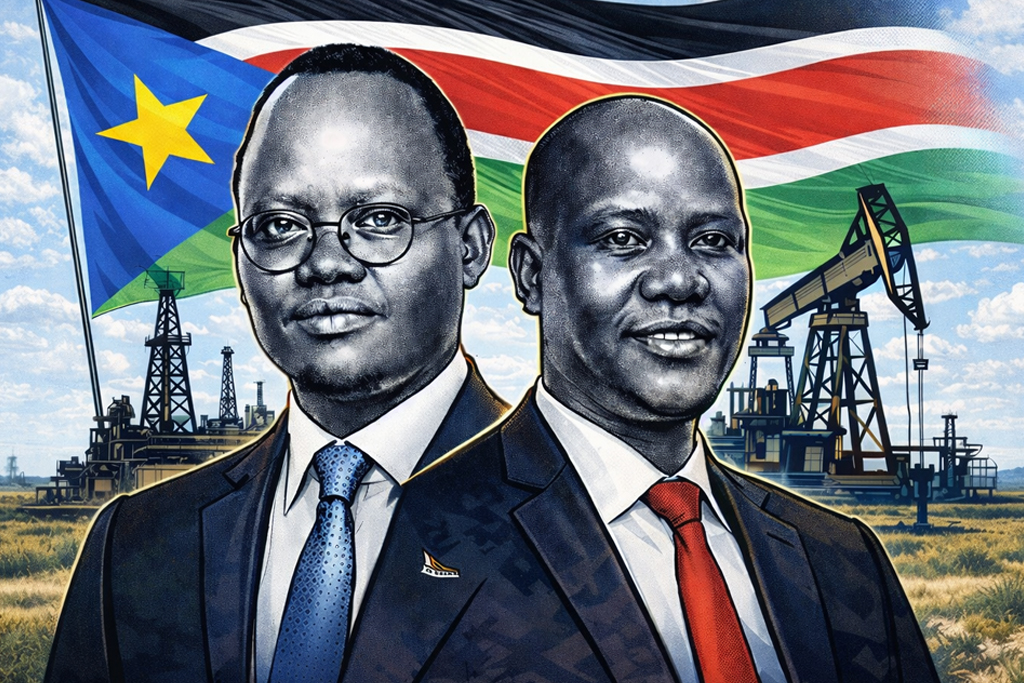
For years, South Sudan has struggled to convince international partners, investors and multilateral institutions that the country could move beyond conflict, opacity and systemic governance failures. Today, a new generation of leadership is beginning to change that perception. At the heart of this shift are two figures whose actions, rather than rhetoric, are redefining the credibility of the South Sudanese state: Dr. Chol Deng Thon Abel, Undersecretary of the Ministry of Petroleum, and Hon. Bak Barnaba Chol, Minister of Finance and Planning.
Together, they embody a break with past practices and signal a return to probity, legitimacy and technical competence at the highest levels of government.
Securing Oil Infrastructure Through Diplomacy, Not Force
The most striking illustration of this new governance paradigm emerged in early December, when South Sudan successfully intervened to safeguard the strategic Heglig oilfield, an installation that could no longer be defended through conventional means. Faced with escalating risks linked to Sudan’s civil war, South Sudanese authorities opted for diplomacy over confrontation.
Mandated directly by President Salva Kiir Mayardit, Dr. Chol Deng Thon Abel negotiated an unprecedented and highly complex tripartite agreement involving Sudan’s Armed Forces (SAF), their rivals the Rapid Support Forces (RSF), and the government of South Sudan. The deal resulted in the withdrawal of Sudanese army units and the distancing of RSF forces from the oilfield, transforming the Heglig area into a neutral zone where no hostilities take place.
Under the agreement, the South Sudan People’s Defence Forces (SSPDF) were deployed to the area to ensure permanent security of the oil infrastructure. According to South Sudanese officials, all oil wells continue to operate normally, with SSPDF assuming full responsibility for securing the facilities.
This arrangement represents a rare geopolitical achievement: a fragile state successfully mediating between two warring factions of a neighbouring country, while protecting its own strategic and economic interests.
A Diplomatic Victory That Redefines South Sudan’s Standing
Negotiated personally by Dr. Chol, the agreement is widely regarded as a victory of influence, diplomacy and respectability for South Sudan. It elevates the country from the image of a conflict-ridden, dependent state—historically dominated by Khartoum—to that of a credible regional actor capable of contributing to peace while safeguarding vital revenue streams.
Dr. Chol’s role as the architect of this technically demanding and politically sensitive deal has significantly strengthened his standing within government circles, effectively securing his position for the months ahead. More importantly, it has pushed South Sudan into a new diplomatic dimension.
Such leadership demonstrates not only the ability to mediate in conflict, but also to protect national interests with authority and integrity. Known for his discreet yet relentless work ethic, Dr. Chol brings rare technical expertise in the petroleum sector, deep knowledge of industry actors, and a stature that combines political weight with diplomatic skill. In contrast to many of his predecessors, he commands credibility across all three domains.
His action rests on three clear pillars: probity, legitimacy and competence.
A Parallel Breakthrough at the Ministry of Finance
This shift in governance is mirrored at the Ministry of Finance and Planning. Upon taking office, Hon. Bak Barnaba Chol moved swiftly to restore confidence with international financial institutions at a particularly delicate moment for the country’s finances.
Within weeks, he successfully negotiated a financial package with the World Bank, securing much-needed funding and sending a strong signal that South Sudan is once again a credible counterpart. In parallel, he managed to halt the short-term dispute involving BB Energy, while opening discussions with international lenders who now recognize that South Sudan is moving toward sounder governance.
Sources close to the ministry indicate that several pan-African banks, particularly from East Africa, have recently requested meetings with the minister to explore potential opportunities in South Sudan. This proactive outreach reflects renewed investor confidence in a leadership team perceived as professional, disciplined and reform-oriented.
BB Energy itself has expressed confidence in the professionalism of the new team to resolve disputes inherited from previous administrations. The World Bank’s decision to extend a new financing line, alongside reassurance from the Trade and Development Bank (TDB) of Nairobi, underscores a broader reassessment of South Sudan’s risk profile.
A Clear Line Against Corruption
Perhaps the most powerful signal of change came with Minister Bak Barnaba Chol’s refusal to meet Idris Taha, Managing Director of EuroAmerican Energy. Taha reportedly entered South Sudan discreetly in an attempt to re-establish arrangements that had existed under previous leadership—arrangements now widely exposed as part of a systemic corruption network designed to siphon off South Sudan’s oil wealth.
For months, citing security concerns, Taha had allegedly relied on intermediaries, including his son, to negotiate opaque deals that secured abnormally high discounts benefiting EuroAmerican Energy, Cathay Petroleum and BGN. These practices are closely associated with figures from the former establishment, including ex–Vice President Benjamin Bol Mel and former petroleum undersecretary Deng Lual Wol.
By refusing any engagement, the minister sent an unambiguous message: those networks are now considered toxic. The suspension of oil cargo deliveries to EuroAmerican Energy has already stemmed a massive financial hemorrhage—revenues that should have benefited the South Sudanese people.
This stance marks a decisive rupture with the past and reassures international partners that corruption no longer has institutional shelter.
Coordinated Leadership at the Highest Level
From the outset, both Dr. Chol Deng Thon Abel and Minister Bak Barnaba Chol initiated a 360-degree review of all ongoing files, aiming to normalize inherited situations, halt ongoing prejudice caused by former teams, and restore trust with international institutions and investors.
In less than a month, the new leadership has demonstrated an unusual level of coordination and momentum. Operating under the mandate of President Salva Kiir, and in close coordination with Adut Salva Kiir, Senior Presidential Envoy on Special Programmes, they are working jointly across all economic and strategic portfolios.
A Turning Point for South Sudan
The emergence of these new faces does not merely signal administrative renewal—it marks a strategic shift in how South Sudan governs itself and engages with the world. By combining technical competence, political authority and ethical clarity, Dr. Chol Deng Thon Abel and Hon. Bak Barnaba Chol are restoring legitimacy to state action.
For international institutions and investors long wary of South Sudan, the message is clear: a new chapter is opening—one defined not by promises, but by decisions, discipline and results