

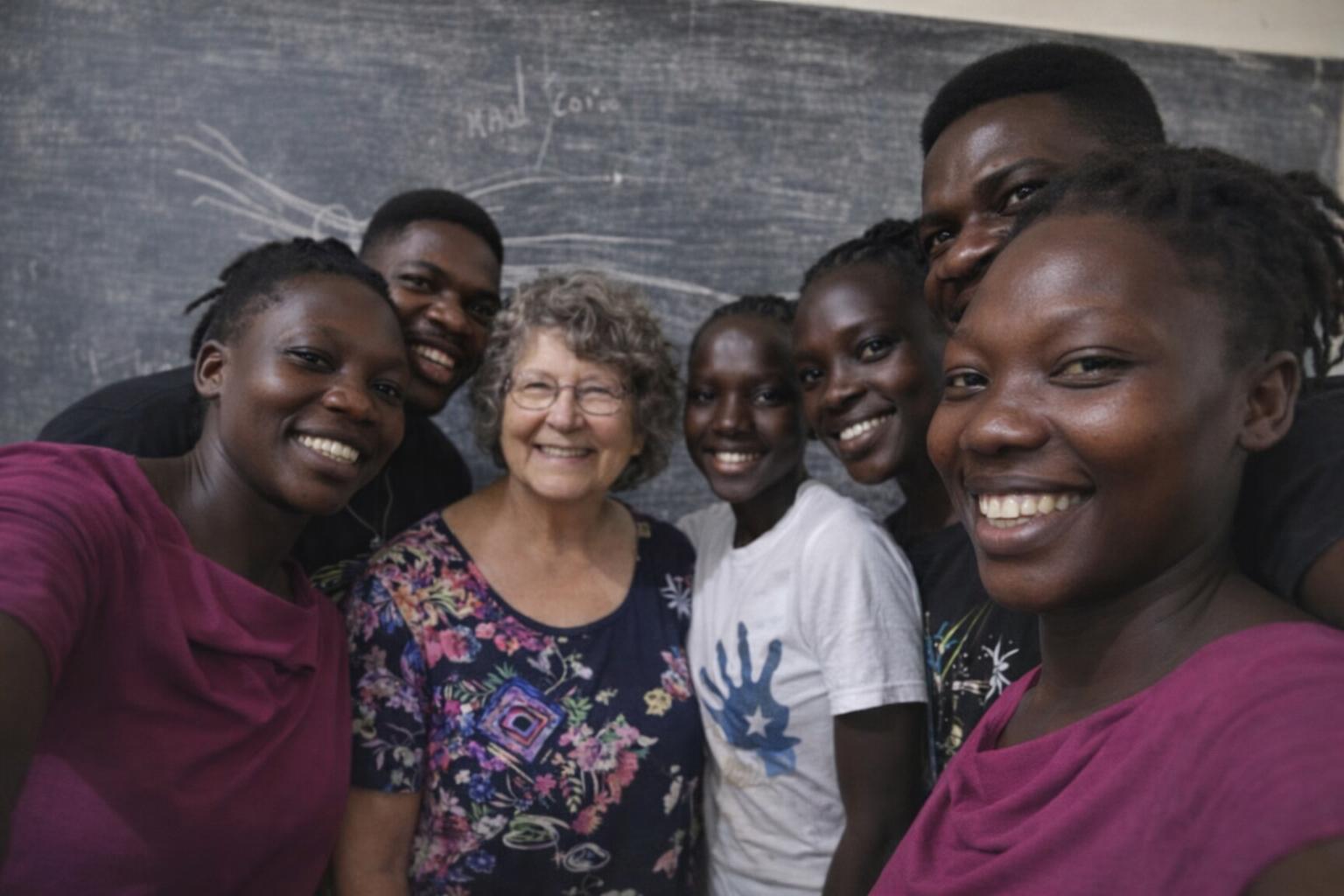
Wau, South Sudan: a mission shaped by conflict
Colette Blockley, a registered nurse, describes a volunteering path that has taken her from Kolkata to Chile, Scotland and Thailand. In 2015/2016, she joined Solidarity with South Sudan, teaching nurses and midwives in classrooms and at Comboni Hospital in Wau.
She returned in 2024 and calls it her most challenging assignment. Blockley writes that South Sudan has faced a civil war since 2013, and that political rivalry linked to opposing tribes has hindered agreement on key national priorities.
South Sudan statistics: hunger, schooling and literacy gaps
Blockley cites a set of indicators that, in her view, frame daily life. She reports that seven million of South Sudan’s 12 million people go hungry each day, while life expectancy is 56.
In the same overview, she states that only 46% of children attend school, placing South Sudan near the bottom globally for primary education and last for secondary education. She adds that 38% of adults are illiterate, and that 92% of women are illiterate despite women comprising 65% of the population.
Her figures also point to early marriage, with 42% of girls married between 15 and 18, and 7% married under 15. She further notes that South Sudan has the highest maternal and child death rate in the world, and that 78% of police are illiterate, a situation she links to unpaid salaries and bribery risks.
Blockley also highlights social complexity, writing that there are 64 tribes. She estimates 6–7 million people are Dinka, and says that within the Dinka there are 25 clans, many of which are in conflict with each other.
Solidarity with South Sudan: training for long-term autonomy
Solidarity with South Sudan is presented as a Catholic organisation focused on building independence through skills. Blockley writes that its work centres on training teachers, nurses and midwives, alongside trauma-healing workshops for people affected by war and education in basic agricultural practices.
She also notes that many communities include third-generation refugees, arguing that displacement has disrupted the intergenerational transfer of farming knowledge. In her account, that loss amplifies vulnerability when food systems are strained.
Comboni Hospital Wau: pressure on wards and families
In Wau, Blockley lived and worked at the Catholic Health Training Institute with five sisters and one priest from different congregations, as the only lay person. She describes a convent on a 60-acre compound, guarded around the clock, with student dormitories, a school and an administration block.
Her reporting from Comboni Hospital focuses on volume and waiting. She writes that hundreds of patients queued for outpatient and emergency care, and that those not seen sometimes slept overnight in the hospital compound, exposed to mosquitos associated with malaria and to snakes.
Blockley describes the emotional intensity of paediatric cases, recalling moments where she could do little beyond basic comfort: “all I could do was keep the flies off the child and hold the hand of the mother.” She adds that some families walked long distances from villages to reach treatment.
Nursing and midwifery training: student resilience in Wau
The nursing and midwifery programme, she says, draws students from across South Sudan for three years. Blockley reports that three quarters of learners are men, which she links to girls often not reaching the education level required for admission.
She repeatedly emphasises perseverance. Many students, she writes, stay away from home for the full three years because they cannot afford travel during semester breaks.
Language is another barrier in her account. Blockley notes that English is a third language for all students, after tribal languages and Arabic, and that English is generally spoken by those who had the opportunity to attend school. She calls their dedication “amazing.”
Malaria, malnutrition and leprosy: disease burdens up close
Blockley writes that malaria is widespread and, in her description, the leading cause of death. She says she contracted malaria on both missions and describes the illness as severe.
She also reports that malnutrition is pervasive, describing two hospital wards filled with critically ill children due to inadequate nutrition. In her narrative, repeated bereavement is a quiet presence, especially among mothers who, she writes, “have been through this before.”
Outside the hospital, she spent a day at the Agok Leper Colony near Wau. She describes residents with leprosy living in scrubland away from others and being largely unsupported, apart from Sister Bibiana, who she says visited weekly with medicine, food and water.
Security constraints and the realities of movement in Wau
Security shaped daily logistics. Blockley says she was considered a kidnapping risk because she is white, and that she travelled between the compound and the hospital with an armed guard and driver.
She adds that desperation has normalised survival crime, and that an interpreter accompanied her in hospital settings because she is not fluent in Arabic. These measures, in her view, reflect a wider environment of fragility.
Climate stress, displacement and the question of hope
Blockley writes that heat and humidity were oppressive and that climate change has “ravaged” South Sudan. She says she noticed a significant difference between 2016 and 2024, and describes communities as disillusioned by a long-running war and limited political solutions.
She also notes refugees arriving from Sudan, saying their movement increases pressure on food availability and can contribute to insecurity. Within that context, she frames faith practice as personal support, writing that daily Mass and shared prayer sustained her.
On prospects, Blockley poses her own question: “Is there hope?” She argues that missionaries are central “at this point in time,” while noting Solidarity with South Sudan plans a gradual withdrawal within 10 years, handing over to trained South Sudanese professionals. She adds that some graduates move to Kenya or Uganda for higher wages to support families.
Blockley ends with a measured reflection on impact, borrowing a line she attributes to Mother Teresa: volunteer work is “a drop in the ocean,” but still matters. She says she does not plan to return, and identifies herself as a professional nursing supervisor based in Dunedin. (Kaitiaki)