

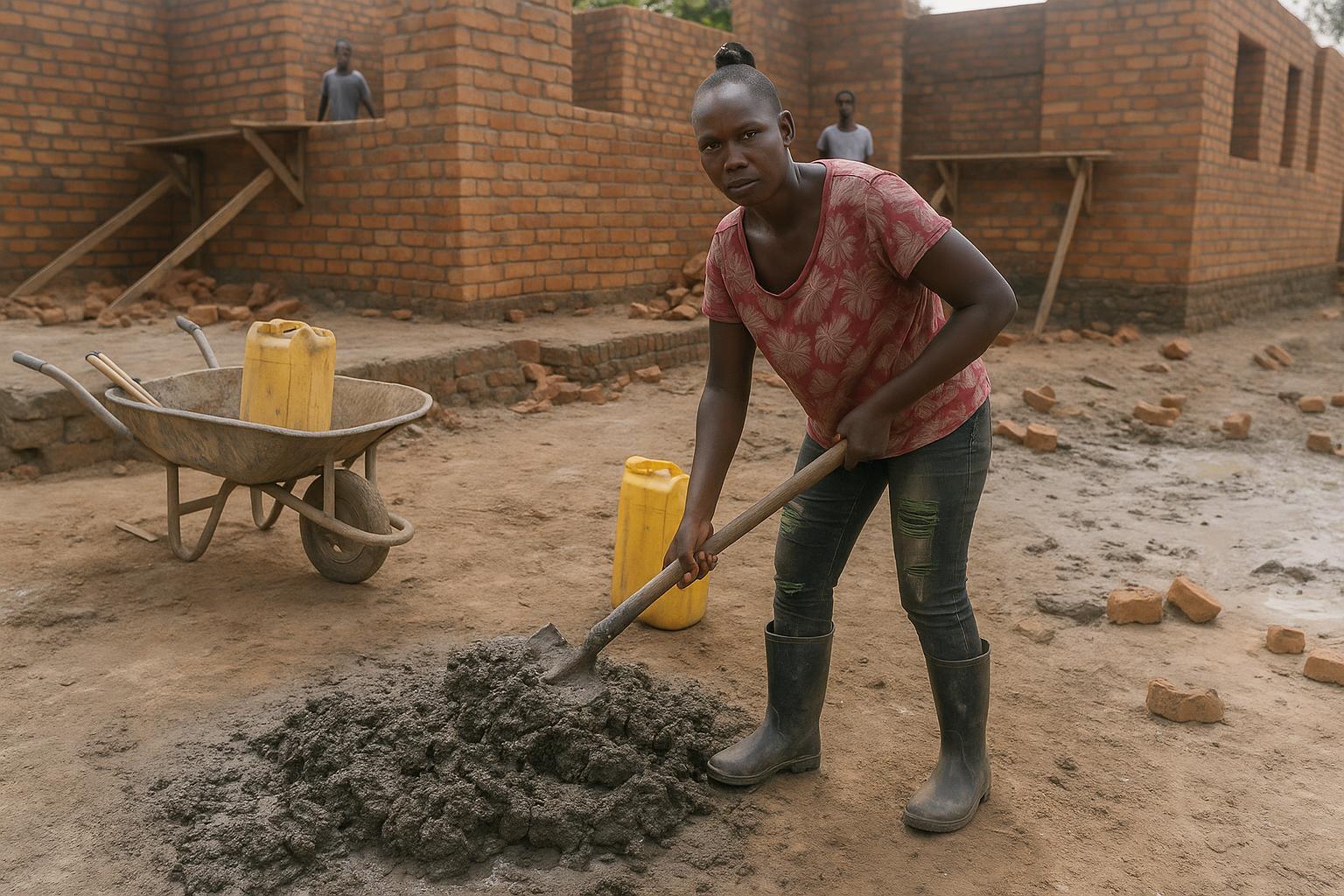
Breaking Gender Barriers in Nzara
In Nzara County, Western Equatoria, 27-year-old Amugima Esther Joseph swapped uncertainty for cement in 2023. Earning about 10,000 South Sudanese Pounds daily, the single mother of four quickly became her family’s bread-winner, collecting 60,000 SSP within six weeks.
“This trowel feeds everyone under my roof,” she says calmly. “Masonry is my anchor, even while I scan the horizon for fresh openings.” Her resolve chips away at long-standing gender assumptions on dusty construction sites.
Land and Harvest: A Dual Foundation
Earlier earnings from the Community Organisation for Peer Educators, where she volunteered before receiving a modest stipend, allowed her to buy two hectares of village land for roughly one hundred dollars.
That plot now produces maize, groundnuts and cassava in commercial quantities: 20 bags, 15 bags and 30 bags respectively this season. The crops cushion household expenses and prove that a single investment can yield parallel revenue streams.
A Culture of Saving Fuels Ambition
Last year she formalised self-discipline by locking away small notes after every job. The metal box under her bed holds nearly two million SSP today, offering a personal safety net in a nation where formal banking remains out of reach for many citizens.
Her next milestone is a micro-enterprise selling building materials. “I laid bricks for others; soon I’ll supply the bricks,” she jokes, mapping a growth plan that could multiply her current daily income.
Applause from Engineers and Friends
Site supervisor Engineer Mark Njunawa Alibi praises her craftsmanship, citing late-evening retouches she makes without being asked. “Skill and integrity meet in her hands,” he notes, adding that colleagues often benchmark their own blocks against hers.
Friend and fellow mason Anita Peter William remembers introducing Esther to the trade. “She works harder than I do,” Anita laughs. Their camaraderie underscores how peer networks can accelerate women’s entry into non-traditional occupations.
Message to Peers Across South Sudan
Esther urges young women to embrace any honest task—dishwashing, street vending, water hauling—until bigger chances arise. Dependency, she argues, creates fragility; enterprise, stability.
Her trajectory from school dropout to mason, farmer and aspiring merchant offers a living syllabus on resilience for youths across South Sudan and the wider continent.