

Africa Elephant Conservation Split Across Regions
In Africa’s elephant story, geography matters. In South Sudan, conservation teams struggle to find even one animal in vast protected areas. In parts of southern Africa, successful protection has concentrated elephants, intensifying pressure on land and raising human-wildlife conflict (The Guardian).
South Sudan Badingilo National Park: Tracking the Last Elephant
Late in a January dry season, smoke hangs over grasslands as people burn vegetation to stimulate new growth. From an ultralight aircraft above Badingilo National Park, observers expect spotting the park’s last elephant to be difficult across nearly 9,000 square kilometres (The Guardian).
A GPS collar, sending coordinates hourly, makes the search possible. The bull elephant’s behaviour also signals its isolation: it reportedly moves alongside a herd of giraffes, a striking image of ecological decline in a landscape once rich in large mammals (The Guardian).
South Sudan Elephant Numbers: From 1970s Estimates to Today
In the early 1970s, English ecologist Dr Murray Watson surveyed wildlife from a bush plane in what was then Sudan. Although his methods were less precise than modern counts, he estimated roughly 133,500 elephants in what is now South Sudan (The Guardian).
US conservationist Mike Fay, who has spent decades documenting wildlife in the Sahel and central Africa, says South Sudan’s known elephant population is now about 5% of what it was 50 years ago. The shift reflects deep, long-running pressures on ecosystems (The Guardian).
African Parks Agreement in South Sudan: Scale and Stakes
In Juba, Fay reviews maps of the connected Badingilo, Boma, and Jonglei landscapes. He describes the scale as “mind boggling”. African Parks, where he serves as landscape coordinator, holds a 10-year agreement with the government to manage 150,000 square kilometres, roughly Nepal’s size (The Guardian).
Fay calls the landscape “the greatest conservation opportunity on Earth” and also one of the hardest challenges any conservation organisation has faced. The framing underscores how protection depends on security, community engagement, and sustained resources over time (The Guardian).
Great Nile Migration Discovery and the Wider Ecosystem
Optimism has been strengthened by a 2023 discovery that this ecosystem hosts what is described as the world’s largest remaining land mammal migration, dominated by white-eared kob. Reporting notes the migration has persisted despite prolonged civil conflict, while other species have struggled (The Guardian).
Elephants are among the fauna that have fared poorly. Conservation workers and local residents describe a landscape where wildlife survival is closely tied to human stability, access to livelihoods, and the practical reach of law enforcement across vast terrain (The Guardian).
Poverty, Ivory and Survival: Voices From Boma and Badingilo
In Boma’s Maruwa village, a hunter says he last saw an elephant four years earlier, and killed his last elephant two years before that. “I was hungry,” he says. He describes earning $50 per tusk, split among five men, an amount reflecting hardship-driven incentives (The Guardian).
Bystanders including goldminers, ex-soldiers, and an unpaid teacher join the conversation. One says they do not believe elephants are all dead, but have moved to “faraway places”. The hunter adds that if he meets another elephant, he would kill it “for food” because “we’re really poor” (The Guardian).
In Badingilo, African Parks community officer David Liwaya, a refugee who returned from Kenya, captures the moral tension: “Who cares about an elephant when you’re losing your brothers?” He argues, however, that abandoning the future is not an option, signalling conservation’s long horizon amid human crisis (The Guardian).
Badingilo’s Last Elephant Reported Killed in 2025
Reporting states that, 11 months after the visit described, African Parks teams said Badingilo’s last elephant was killed at the end of 2025 by suspected poachers, along with one giraffe companion. The episode illustrates how a single animal can become a symbol of wider systemic strain (The Guardian).
Southern Africa KAZA: Successes Bring New Pressures
In southern Africa, the challenge reverses. In parts of the Kavango Zambezi Transfrontier Conservation Area (KAZA), spanning Botswana, Namibia, Zambia, Zimbabwe and part of Angola, enforcement and conservation are described as so successful that communities now struggle with too many elephants (The Guardian).
On KAZA’s eastern edge, people and elephants are increasingly confined to smaller parcels of land with limited ecological resources. Governments, communities and conservationists debate responses including culling for food, regulated hunting to raise income, fencing, and translocation (The Guardian).
Zimbabwe Victoria Falls: Human-Wildlife Conflict in Daily Life
Outside Victoria Falls International Airport, a roadside warning points to elephants on the move. In Mkhosana township, residents describe frequent human-wildlife conflict, which reporting links to climate stress as elephants search for food and water during worsening drought conditions (The Guardian).
Fransica Sibanda says an elephant trampled her husband close to their home. “I now live in fear,” she says, calling for fencing or for elephants to be driven away. Neighbour Ireene Nyathi recounts seeing a man picked up and crushed against her wall, adding that the elephant “should be found and shot” (The Guardian).
Miriam Esther, a local water development coordinator, argues that the visitor experience can obscure local realities. “Tourists don’t see this,” she says, describing how many come for hotels, the falls, and photographs, while communities carry the risks at the park boundary (The Guardian).
Hwange National Park: Density, Drought and Ecological Imbalance
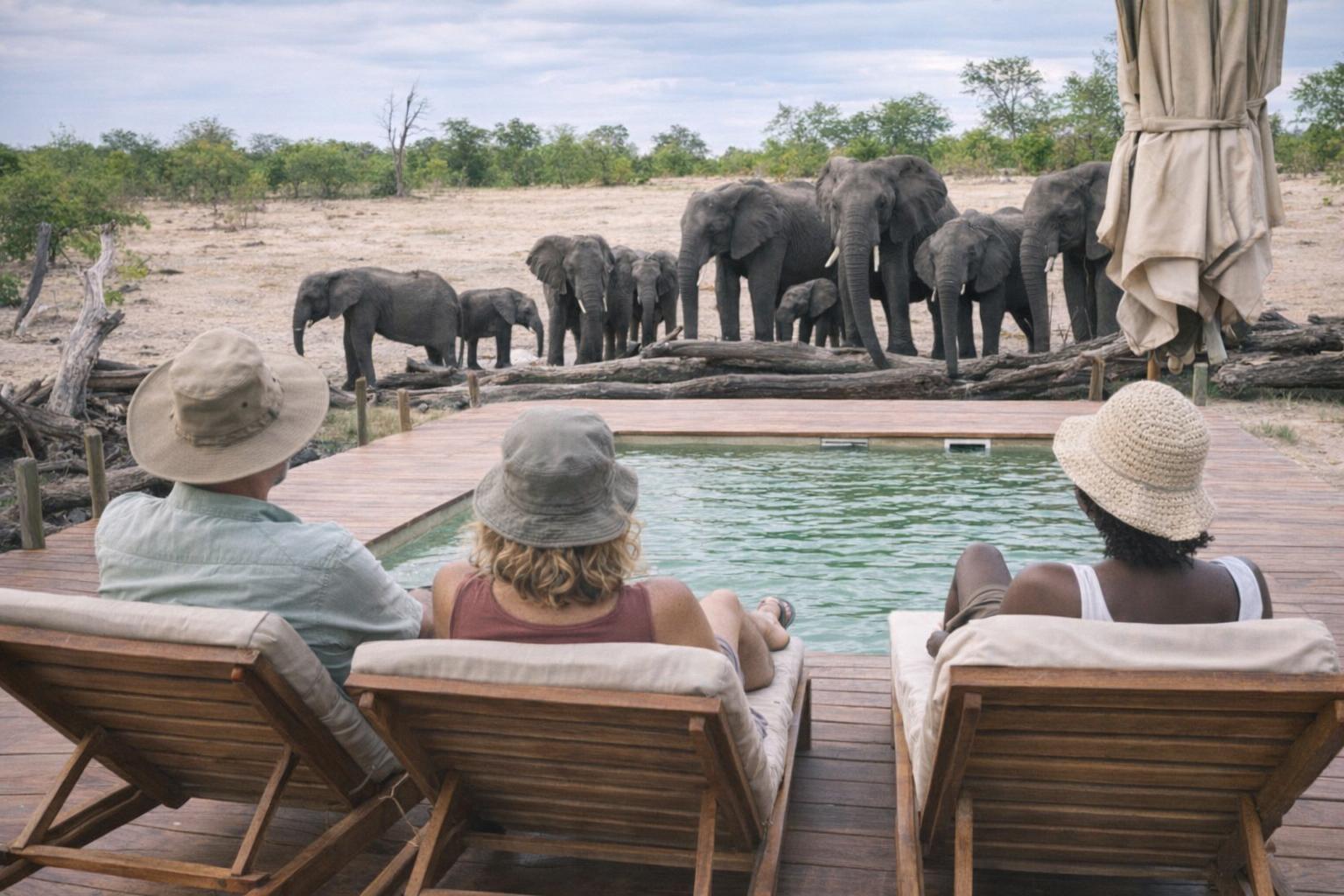
Near Hwange National Park, elephants appear in front of safari lodges, creating the iconic imagery that supports tourism. Yet field observations also include elephant carcasses near watering points, a reminder that high density and environmental stress can translate into visible mortality (The Guardian).
Safari guide and conservationist Rob Janisch says roughly 60,000 of Zimbabwe’s estimated 100,000 elephants pass through Hwange in the dry season, about twice the region’s capacity. He links the situation to past interventions such as pumped water holes in an arid area and reduced migration (The Guardian).
Janisch notes that artificial water provision was once considered a conservation necessity, though “hindsight would prove otherwise”. The account highlights how historical management decisions can shape present ecological dynamics, especially where settlements and land use limit animals’ ability to range freely (The Guardian).
Culls, Hunting Revenue and the Politics of Conservation Choices
Reporting says that in late 2024, Zimbabwean and Namibian authorities announced significant elephant culls, sometimes involving big-game hunters who generate revenue. Botswana, it adds, floated a similar approach, triggering international criticism. The debate illustrates competing ethical and economic frames (The Guardian).
In Victoria Falls, taxidermist Godwill Ruona calls elephants “the heartbeat of the bush” while arguing there are too many. “You can’t sit in Paris and tell us what is happening in Zimbabwe,” he says, reflecting a recurring theme: local costs can shape local policy preferences (The Guardian).
Coexistence Tools: Fences, Deterrents and Limits
Some community-level measures show results, including deterrents such as whips that sound like gunfire, bonfires, and “chilli fences” that irritate elephants’ sense of smell. In places like Ngamo, communities invest in high-voltage fencing intended to separate villages from park boundaries (The Guardian).
Even effective deterrence does not resolve a structural fact: elephants require space to move. Where landscapes are fragmented, conflict tends to re-emerge elsewhere, suggesting that short-term tools may need to be paired with broader land-use planning and cross-border coordination (The Guardian).
Elephant Translocation and Funding Constraints
Translocation can work in specific cases. Reporting cites a 2016 operation in which African Parks moved 500 elephants between two parks in Malawi, described as the largest in-country elephant relocation undertaken. Such operations, however, are costly and logistically complex (The Guardian).
With conservation NGO budgets reportedly being cut across the continent, scaling up relocations is challenging. The article’s broader implication is that sustainable elephant policy often depends on stable financing, consistent institutions, and partnerships that align ecological goals with community benefits (The Guardian).
What the Elephant Divide Reveals About Africa’s Conservation Future
From South Sudan’s near-absence to southern Africa’s crowding, the elephant divide shows that conservation is not a single narrative of decline or recovery. It is a patchwork shaped by security, poverty, climate stress, historic management choices, and the uneven distribution of protected space (The Guardian).
Reporting stresses that well-managed landscapes and grassroots conservation efforts can deliver notable gains. Yet the cases also show that without viable coexistence strategies, both scarcity and abundance can become destabilising. In a period of accelerating biodiversity loss, long-term commitment remains central (The Guardian).