

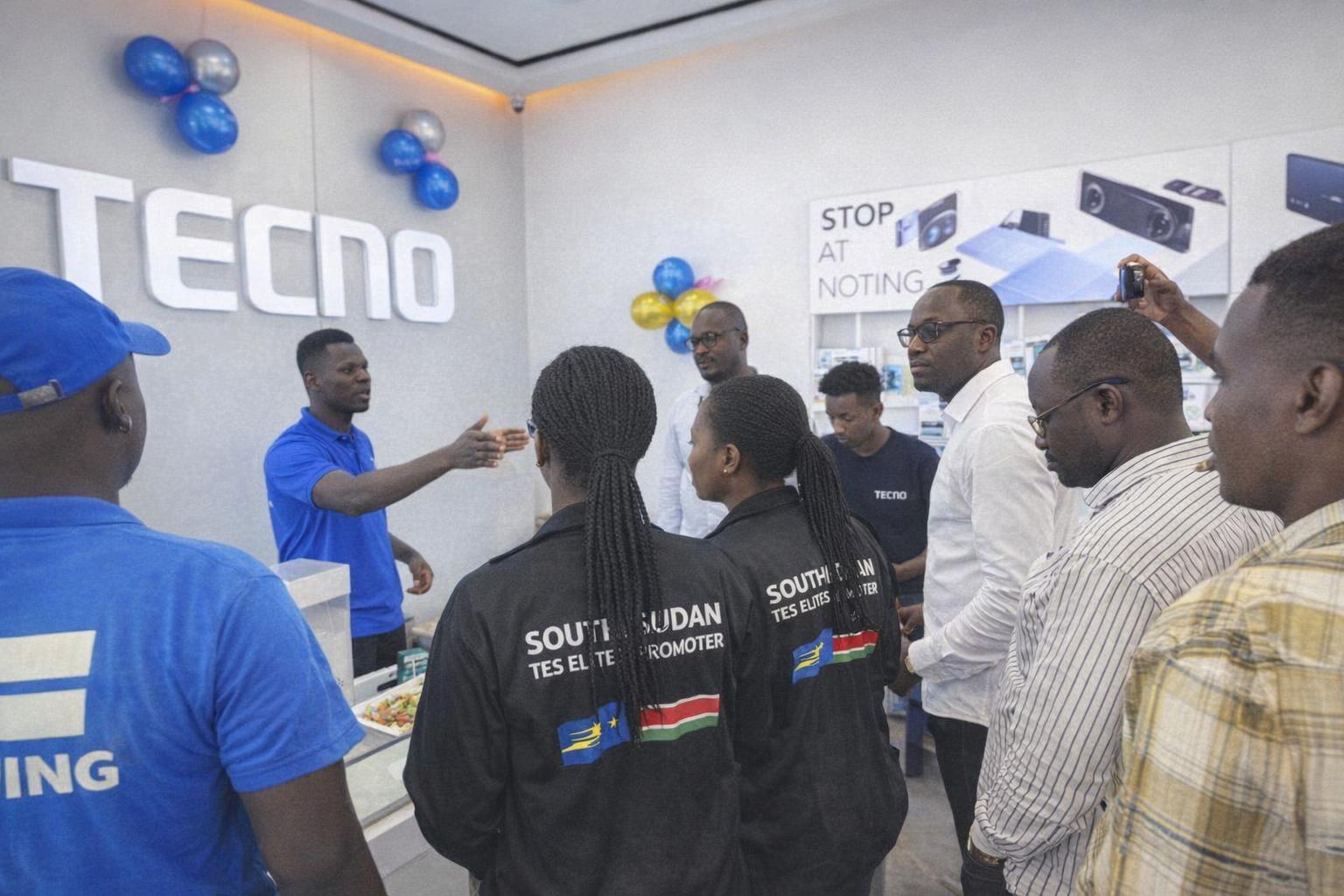
South Sudan smartphone market draws new retail investment
TECNO, a Chinese smartphone maker, has opened its first flagship retail store in South Sudan, a notable private-sector move in an environment where digital public infrastructure is often described as limited.
The launch comes as smartphones are increasingly treated as essential tools for communication, mobile money and access to digital services, despite recurring constraints linked to internet reliability, power supply and digital payment systems.
TECNO says flagship shop signals long-term commitment
Henry Khamis, TECNO’s brand manager in South Sudan, framed the store opening as a statement of sustained engagement with the local market and a bid to broaden access to what the company calls quality devices.
“Today, we are very excited to launch one of the best shops in the Republic of South Sudan, the TECNO Exclusive Shop,” Khamis said, adding that the company aims to offer “quality and a premium experience.”
Positioning Juba within the East Africa technology market
Khamis linked the flagship concept to a wider strategy to modernise smartphone retail, while also projecting South Sudan as part of the East African technology landscape, where digital infrastructure is often seen as more advanced.
“We want to change the look of the market and demonstrate how South Sudan can compete with other markets in East Africa,” he said, describing the shop as an investment in design standards, product quality and customer experience.
Hands-on experience zone targets trust and digital literacy
The store includes an experience zone where customers can test smartphones and accessories, a retail model commonly used to build confidence in new technologies, particularly in settings where digital literacy remains uneven.
The approach also supports buyers who want to compare features in person before purchase, a practical consideration in markets where devices may serve multiple functions in daily life.
Smartphones, wearables and accessories on display
TECNO is showcasing smartphones alongside smart earphones, smartwatches, power banks and data cables, reflecting a broader push by manufacturers to build device ecosystems around everyday digital use.
Among the highlighted products are the TECNO Smartwatch Pro 2 and TECNO Smartwatch 3, described as waterproof options designed for daily wear and aimed at consumers seeking affordable wearable technology.
Popular models: Camon 40 Pro and Spark 40 Pro Plus
TECNO promoter Pascalina Kiden Ismail said customers are attracted to devices that balance design, durability and features aligned with local needs. “I promote TECNO because it offers high-quality smartphones with attractive designs and advanced features,” she said.
Ismail pointed to the Camon 40 Pro and Spark 40 Pro Plus as strong sellers, linking demand to photography, media use and home connectivity, particularly where smartphones can substitute for computers.
“The Camon 40 Pro is unique because it is waterproof and has a very high-quality camera,” she said, adding that users value image clarity when zooming and the ability to connect the phone to a TV at home.
MTN partnership highlights connectivity and service expansion
Telecom operator MTN said the new store reinforces cooperation between device manufacturers and network providers, which it described as an important element of South Sudan’s evolving digital ecosystem.
Baiti Haidar, an MTN representative, said the collaboration is expected to support access to connectivity and digital services beyond Juba. “We remain fully committed to supporting TECNO as it continues to grow its business,” Haidar said.
TECNO’s global footprint through Transsion Holdings
TECNO is owned by Transsion Holdings, a Chinese technology group headquartered in Shenzhen. The brand, founded in 2006, focuses on emerging markets across Africa, the Middle East, South Asia and Latin America.
Company positioning emphasises affordability, durability and adaptation to local user needs, aligning its product strategy with markets where smartphones are central to day-to-day digital participation.